Are Telescopic Fishing Rods Worth It? An Honest Look
Short answer: yes for some anglers, no for others. Buy one if you need a rod that lives in a backpack, a car, or a suitcase, and you fish light lures. Don't buy one if you're chasing big fish, need maximum casting distance, or care about feel above everything else.
Everything below is the reasoning behind that.
What a telescopic rod actually is
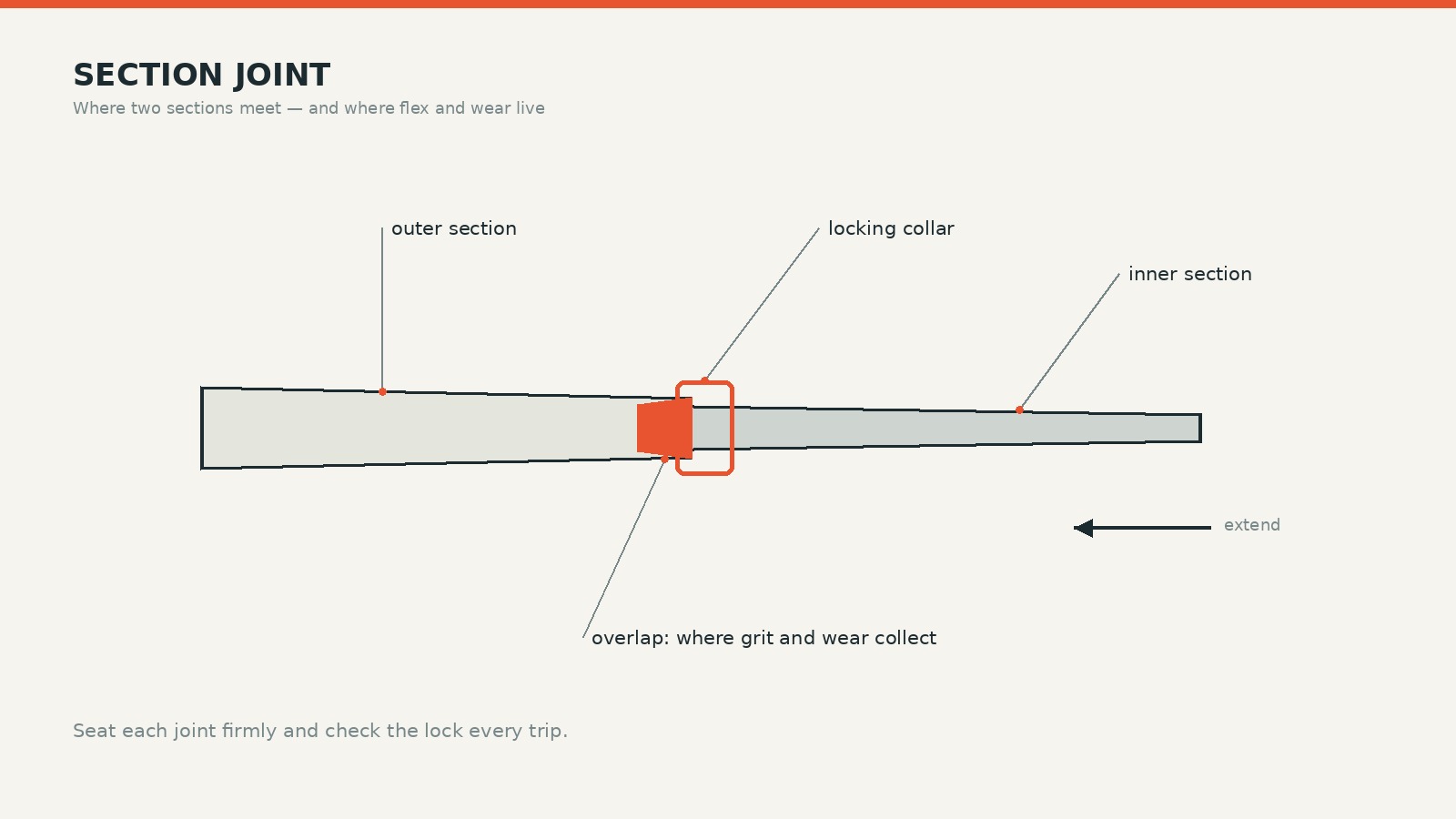
A telescopic rod is a set of tubular sections that slide inside one another. You extend them from the butt toward the tip and each joint locks — either through a tapered friction fit or a twist-lock collar. To pack it down you reverse the motion and the sections collapse into the butt section.
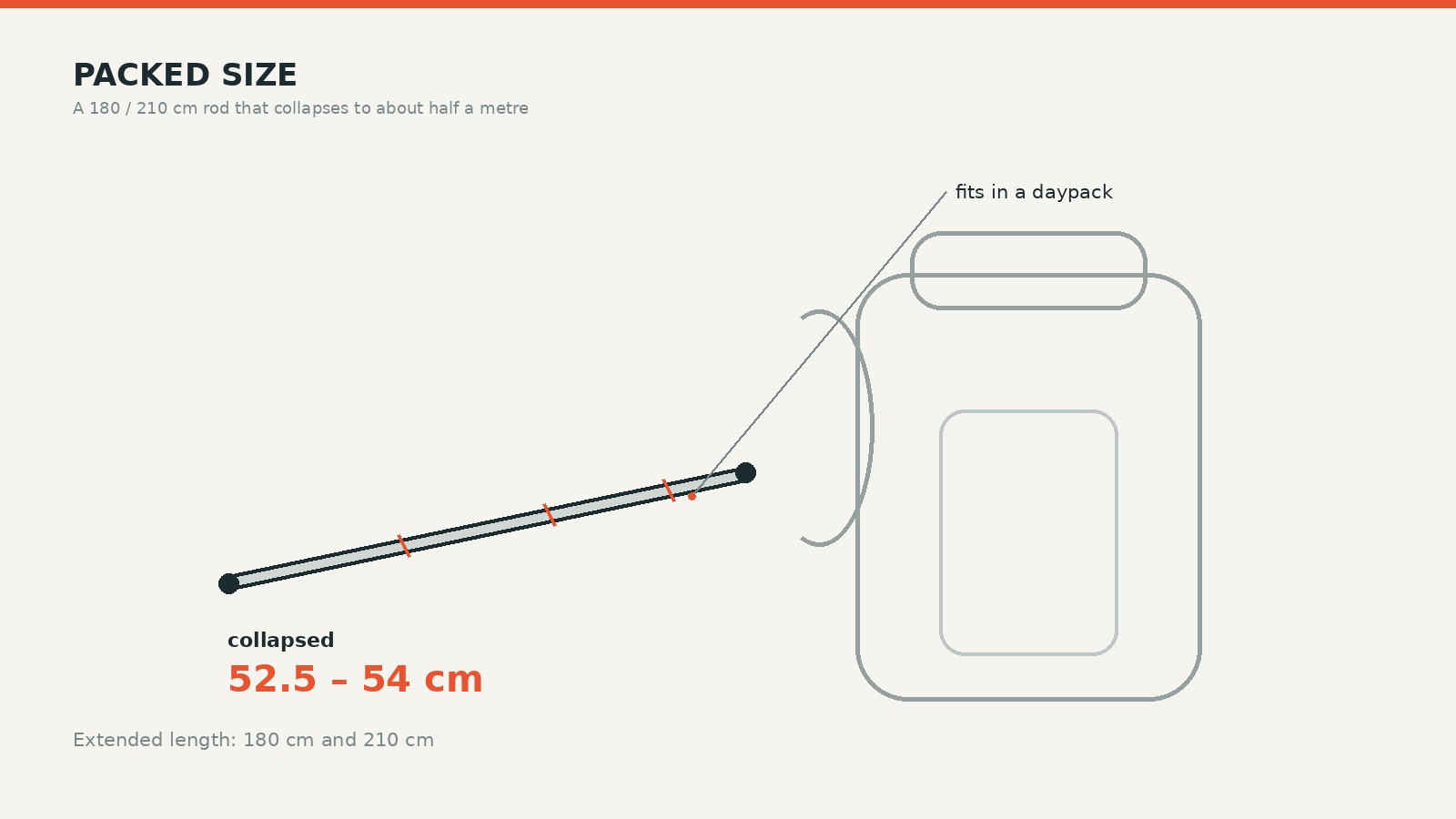
Our two models run 180 cm and 210 cm extended, and collapse to 52.5–54 cm. The collapsed number is the entire point: a rod that fits inside a daypack instead of riding on the roof.
The catch is the joints. Every telescopic rod has them, and every joint is a place where two surfaces meet without being fused. Under load they flex slightly differently from a continuous blank. Over time grit, salt, and repeated extending wear those surfaces, and a joint that was tight in spring can develop a small amount of play by fall. That isn't a defect unique to one builder — it's the physics of the design. It's also why the locking mechanism matters more than almost anything else on the rod.
Three real advantages
Portability. This is why the category exists. At 52.5–54 cm collapsed it goes in a backpack, under a car seat, in a motorcycle pannier, or in a suitcase. A two-piece rod of the same length packs to roughly half its extended length and doesn't. If your fishing is opportunistic — traveling, hiking, or keeping a rod in the car in case you pass water — this single difference outweighs a lot.
Good enough for a lot of fishing. Ours are ML power with a 7–15 g lure rating. That covers the weights most freshwater anglers actually throw: small crankbaits, soft plastics on light jigheads, small spinners, lightweight topwater. It is not a rod for big swimbaits or heavy cover, and we don't market it as one.
A lower barrier to trying. If you're not sure lure fishing is for you, a telescopic rod lets you find out without a full-size rod and a rod tube to store. Less commitment, less storage, fewer explanations about why there's a seven-foot tube in the hallway. That's a real advantage for a beginner even though it isn't a performance one.
Three real downsides
Joint wear and play. Each joint is a wear point. You'll feel a bit of flex at the joints under load, and across seasons a joint can develop slight play. The answer is maintenance, not magic: extend firmly, check the lock every trip, keep grit out, and if a joint starts to feel loose, inspect the locking collar before you fish it again. A telescopic rod asks for more attention than a one-piece. If you won't give it that attention, don't buy one.
Casting feel is less direct. A continuous blank carries load and vibration as one piece. A telescopic blank carries it through several joints, and some energy goes into those interfaces instead of the cast. You notice it most with light lures and quick wristy casts: the rod feels slightly softer and less precise than a good two-piece of the same rating. It still casts. It just doesn't feel as crisp.
Fewer guides, and constrained placement. Sections have to slide past one another, so guide placement can't follow the same layout as a one-piece or two-piece build. Fewer guides means the line is supported at fewer points, which shows up as more line contact with the blank under load — most noticeable when a fish is close and the rod is deeply bent. On a light freshwater rod that's a manageable trade; on a rod built for hard fights it wouldn't be.
How it compares with two-piece and one-piece rods
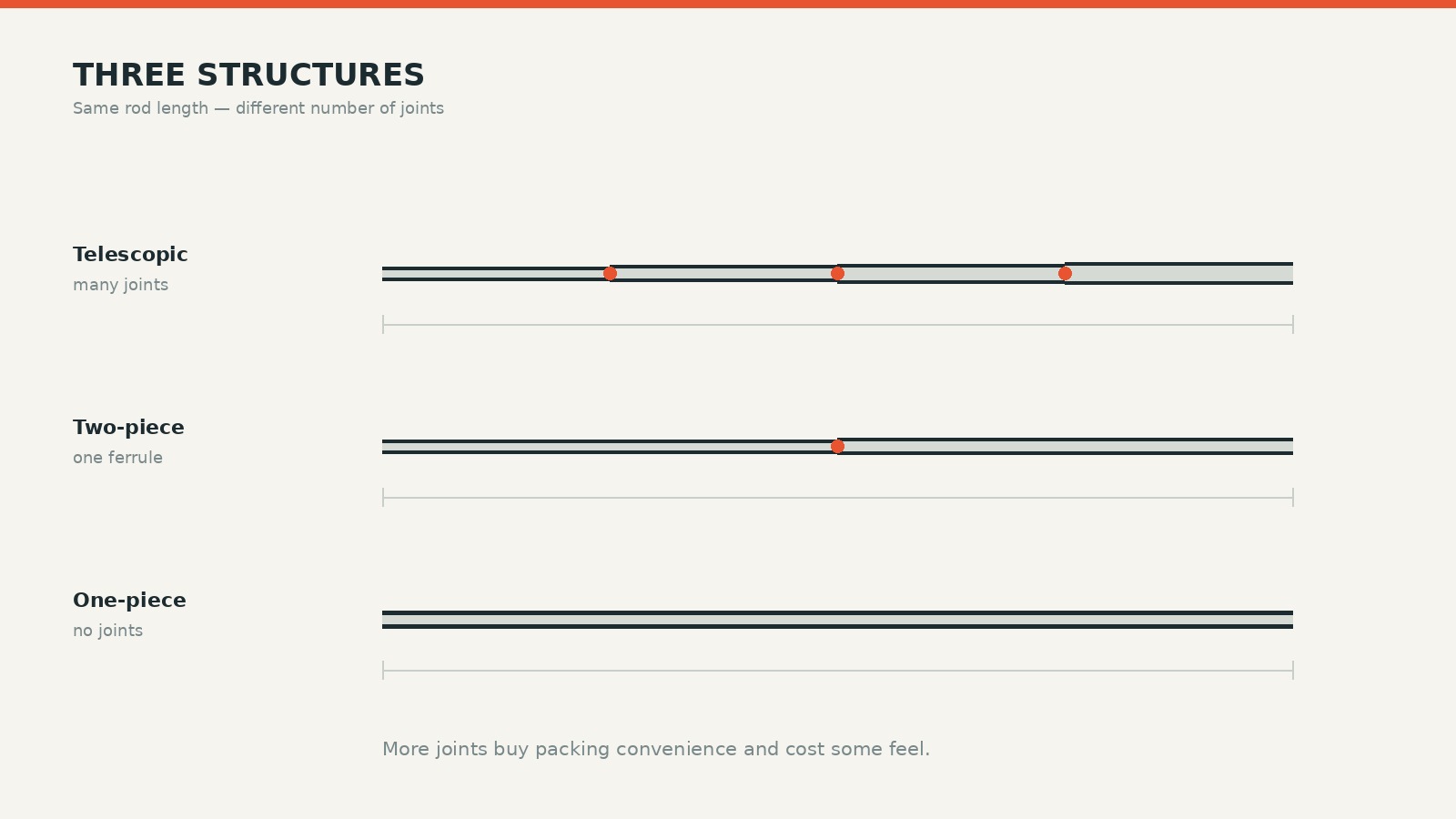
A two-piece rod breaks at a ferrule near the middle. Packed length is roughly half the rod, it casts and feels noticeably closer to a one-piece than a telescopic does, and the ferrule is a single joint you can inspect and clean. If performance per dollar matters more than packed size, a two-piece is usually the better buy.
A one-piece rod has no joints: the most direct feel, the fewest failure points, and the cleanest casting manners. It's also the least portable — a 2.1 m one-piece doesn't go in a backpack, and that's the end of that conversation.
A telescopic rod sits at the portability extreme: smallest packed size, most joints, most compromise in feel. That's the honest ranking. The question isn't which design wins — it's which compromise you can live with.
When a telescopic rod is worth buying
- Backpacking and hiking. You're already carrying weight; the problem isn't mass, it's length.
- A rod that lives in the car. At about half a meter collapsed it fits under a seat and is there when you pass water.
- Travel where a rod tube is impractical. Carry-on luggage, motorcycle, bicycle.
- A backup rod. Keep one in the trunk so a broken tip doesn't end a trip.
- Testing whether you like lure fishing. A low-commitment way to find out.
When it isn't
- Big fish and heavy cover. An ML rod rated 7–15 g isn't built for that, and convenience doesn't change a rating.
- Distance casting. More joints and fewer guides cost you distance and control at range.
- Feel-first fishing. Slow retrieves where you need to feel a soft take are where the compromise is most obvious.
- Fishing every weekend for years. If the rod lives in your hand rather than a bag, a two-piece will serve you better over time.
What to look for if you buy one
The locking system. Twist-locks are more secure than a pure friction fit but add a step to setup. Extend each section firmly, lock it, then give the rod a gentle wiggle with the tip raised — if a joint moves independently, it isn't seated.
Guides. Look for SiC inserts. They're harder and smoother than aluminum oxide, which matters if you fish braid, and they're standard at this level. Check that frames are straight and the guides line up when the rod is extended.
Blank dimensions and weight. Ours run a 1.4 mm tip and 10.5–12.6 mm butt at 113–141 g, depending on length and spec. Those numbers describe a light freshwater rod, not a heavy-duty tool.
Collapsed length. 52.5–54 cm on ours. Measure the bag you plan to put it in before you buy, not after.
Wall consistency. Run a thumb along each section. A good blank feels even, with no thin spots near the joints and no rough patches in the finish.
Why we carry one
We focus on telescopic rods because for a lot of anglers the alternative is no rod at all. Not everyone has a garage wall, a rod rack, or a car with a trunk long enough for a tube. A rod that fits in a backpack gets used. A rod that doesn't, doesn't.
We're not going to tell you it outperforms a two-piece, because for plenty of fishing it doesn't. It's the right rod for a specific set of circumstances, and when those are your circumstances it's genuinely good. When they aren't, buy a two-piece and be happier.
The specs are on the white rod combo page. If you want more on fishing light tackle, our blog has the rest.